

Surely you’ve already heard the story of the AL East: the last place Toronto Blue Jays go from worst to first in the division. Then they go all the way to the 9th inning in Game 7 of the World Series before losing a heartbreaker. Now the roster could be even stronger than last season’s? The 2026 AL East is stacked with Aaron Judge’s Yankees and a legitimate team in Boston, especially after their scorching hot summer. Don’t sleep on the Orioles with Pete Alonso powering that lineup now. Plus Tampa Bay looks to turn the corner after a lost season at Steinbrenner Field. No shortage of roster moves and offseason changes surely make this a division to keep an eye on.
The 2026 MLB season ushers in The BetCrushers’ 7th Annual Division Preview series. We look for value in the futures markets in this labor of love, especially regular season win totals. We appreciate all of our faithful and new readers! (Win totals referenced in each team’s header are courtesy of Caesars Sportsbook, a widely-available sportsbook in the U.S.A.)

2025 Division & American League Pennant Winner: Toronto Blue Jays
2025 AL East Final Standings
- Toronto Blue Jays (94-68)
- New York Yankees (94-68)
- Boston Red Sox (89-73)
- Tampa Bay Rays (77-85)
- Baltimore Orioles (75-87)
Toronto Blue Jays 2026 Win Total: Open 91.5, Now 88.5
2025 Win Total: Over 79 (94-68 / Pythag: 88)
Ten years after winning their last division crown, the Toronto Blue Jays jumped ahead of the Yankees for their 7th AL East title. Then they beat New York decisively in the Divisional Series before grinding their way to Game 7 of the World Series. Going from last to first in the division and marching to the pinnacle of the sport was a turnaround of epic proportions. Despite a handful of roster subtractions including standout hitter Bo Bichette, this squad is in tact and ready for another crack at the franchise’s third World Series Championship.
Offseason Personnel Changes
Additions:
- D Cease (SP-R)
- Kazuma Okamoto (1B/3B)
- J Sanchez (OF)
- C Ponce (SP-R)
- Ty. Rogers (RP-R)
Subtractions:
- B Bichette (SS)
- C Bassitt (SP-R)
- S Dominguez (RP-R)
- C Green (RP-R)
- J Loperfido (OF)
BetCrushers 2026 Win Projection Range: 84 – 97

— Position Players —
Toronto started the 2025 season on a slow note offensively that put them at a 13-16 record on April 29th. It looked a little too familiar to the prior season when the Jays hit at a near-league average rate and finished at 74-88 – dead last in the AL East. Business then began to pick up to the point where the Jays finished with the best batting average (.265) and on-base percentage (.333) in the MLB. Their 11th most home runs (191) and 28th most stolen bases (77) did not move the needle much; striking out at a league best 17.8% rate surely did. And it did not hurt being a top four fielding team either.

Vladimir Guerrero Jr.’s monster 14-year/$500M contract extension started out with a bang. Those are huge numbers, especially for a first baseman. Fortunately, the big fella followed up on his elite 5.3 WAR 2024 season with 3.9 WAR – a very worthwhile result. Over the last five seasons Vladdy made 680+ plate appearances in each and posted a 132 wRC+ or better in four of them. This is his age 27 season and the projections continue to be very high for the centerpiece of the Blue Jays lineup. Great plate discipline and 50%+ hard contact keep his outlook in the stratosphere as a plus-50% hitter in 2026.
Shuffling the Flock
2026 is the first season that Guerrero won’t be on the same lineup card as Bo Bichette. These two debuted in 2019 and have been key producers in the Jays lineup ever since. Bichette’s injury-plagued 2024 season is about the only exception to this statement. The line on Toronto’s former shortstop is simple: great hitter (career .294/.337/.469, 122 wRC+) with shaky defense. 2022 and 2025 were Bo’s worst fielding seasons, and his defensive profile makes him more suitable for second or third base.
Andres Gimenez is essentially the opposite style of player as Bichette: premium glove at the expense of power. The left-handed hitter is also a bigger threat to run…when he can get on base. He and fellow former Guardians infielder Ernie Clement will patrol Toronto’s middle infield without Bo in the picture. Clement established a wRC+ baseline just below average the last couple seasons while Gimenez’ profile sits slightly below that after lower body injuries cut into his 2025 season. Lofty expectations as one of the best defensive duos are very much warranted and should serve as the key fielding upgrade for the 2026 squad.

Japanese corner infielder Kazuma Okamoto brings his big bat to the MLB where, like most other international imports, projections are dampened quite a bit. The right-handed hitter’s last three seasons with the Yomiuri Giants clocked in at 180, 161, and 210 wRC+ via considerable power and plate discipline. League adjustments leave him short of Bo Bichette’s 2025 production by 15-20% though. That’s a reasonable projection with some upside in case the 29-year-old’s power translates to the MLB better. Plus he has a positive track record fielding third base, so there shouldn’t be much of a dropoff – if any – from the collective effort of Ernie Clement, Addison Barger, and Will Wagner.
All Wings on Deck
One point from last year’s preview was “less-experienced players will have a considerable impact one way or another throughout the campaign.” I can’t say we saw Addison Barger, Nathan Lukes, Myles Straw, and Davis Schneider combining for 7.1 WAR though. The follow up from this crew is likely less potent as Straw and Schneider arguably outperformed their baselines. Both of them still have value as short-side platoon partners. That’s a good thing with Jesus Sanchez now on board. He’s a plus hitter against right-handed pitching but has no business being in the starting lineup with a lefty on the mound.
Addison Barger, however, earned a primary role as a corner outfielder or a platoon bat with Okamoto at third base. The left-handed hitter is a small defensive liability in the outfield but certainly deserves to be in the lineup more often than not after slashing .243/.301/.454 with 50.9% hard contact. Nathan Lukes settled in as a plus hitter and solid defender across all three outfield spots with a considerably larger workload in season three.
It’s a good thing that manager John Schneider has a deep stable to fall back on. Switch hitter Anthony Santander fizzled in his Toronto debut, posting the lowest wRC+ (61) among all Blue Jay hitters with 50+ plate appearances. Outside of his first two seasons in the Majors, Santander notched career worsts across his slash line (.175/.271/.294) as well as 27.6% strikeout rate and .219 BABIP. Now he’ll miss most of this season after going under the knife to address a shoulder injury setback. As tough as it will be to repeat last year’s offensive explosion, losses should be confined to about 4-7%.
The Impact of Experience
Toronto’s deep bench enables 36-year-old George Springer to spend a lot more time in the DH spot. Springer apparently found the fountain of youth, putting up a vintage 5.2 WAR season behind a career-best 166 wRC+ and 46.7% hard hit rate. I’ll splash cold water on his heater by pointing to a .340 BABIP and his worst fielding results. This is a man who needs his legs rested, especially if he is expected to retain some semblance of positive base running grades. Regardless, John Schneider will surely take a savvy plus-20% hitter atop the lineup once again.
Strong defenders in reserve support elite centerfielder Daulton Varsho. Injuries limited the 29-year-old to just 71 games after shoulder surgery shortened his 2024 season. Naturally, he is projected for a touch less playing time than in the peak seasons of 2022-2023. But you still get an average bat with good speed when Varsho is in the lineup; just not quite as potent as 2025’s 123 wRC+ suggests.
On the topic of elite defense, Toronto’s backstop tandem of Alejandro Kirk and Tyler Heineman graded out as the best unit in the MLB. The 34-year-old journeyman Heineman will be hard pressed to slash .289/.361/.416 again, especially in his splits against southpaws (.395/.449/.558). Kirk, however, has favorable projections across the board again. Plus-20% hitting and superb defense leave durability as the only true concern. Catching prospect Brandon Valenzuela is not quite ready to lean on though. This is a common theme with this roster as the position player prospect pipeline is not ready to impact the 2026 lineup. The Jays should repeat as a top three fielding team with this cast of characters.
— Rotation —
With an offense as robust as the Jays’, the rotation did not need to be a strong point for this club to make waves. Our key concern going into the 2025 season was lack of depth and limited upside with their usual suspects. Workload ticked down, though still respectably mid-pack as workhorses Kevin Gausman (193.0 IP), Chris Bassitt (169.1 IP), and Jose Berrios (164.0 IP) led the way for a third straight campaign. In terms of effectiveness, 4.34 ERA, 4.46 FIP/4.19 xFIP, and 22.2% strikeout rate were Toronto’s worst rotation numbers since 2020.

41-year-old Max Scherzer succumbing to injury was almost a given at his age. Mad Max missed the first three months of the regular season, found a foothold in the closing months, then dug deep to deliver three postseason starts. He re-signed with the Jays last week as a 4.00+ sixth/depth starter who should replicate his 17 starts and 85.0 innings. The real needle mover was inking coveted free agent Dylan Cease to a 6-year, $210M deal after a down season in San Diego. Succumbing to a 4.50+ ERA is nothing new for the phenom who has now notched 200+ strikeouts in five straight seasons via elite stuff and by staying healthy to annually make 32+ starts. BABIP fluctuation hides behind Cease’s roller coaster ERAs, though three consecutive years of falling hard hit rates and increasing whiff rates point toward mid-3.00s production beating Bassitt’s 2025 contributions by 1-2 wins.

Topped Off With Experience
In the midst of Tommy John surgery rehab last summer, former Cleveland ace Shane Bieber was added to the roster. Although the 150-inning threshold appears out of reach for the 30-year-old righty due to the lingering effects of forearm fatigue, Bieber’s 3.57 ERA and 4.47 FIP/3.35 xFIP across seven outings offers promise for 20+ starts. The former Cy Young Award winner delivered his characteristic command and ground ball tendencies, signs of better things to come. Bieber’s success in 2026 likely hinges on curtailing last season’s rough home run rate (1.79 HR/9 innings) and hard contact (48.2%), acknowledging that he’s not the whiff-generating fastball/slider guy any longer.
Going back to 2024, eroding underlying numbers of Kevin Gausman and Jose Berrios created uncertainty in their 2025 projections. Berrios’ second half collapse pushes his 2026 outlook into the 4.00+ range that likely relegates him to long relief and/or a swingman role. 35-year-old Gausman rebounded with 3.59 ERA, 3.41 FIP/3.77 xFIP, and 4.1 WAR on a career-low .262 BABIP. Credit is due to the veteran for regaining the effectiveness of his trademark splitter and improving the sinker he brought back into the fold in 2024. Balancing this out is a second straight sub-25% strikeout season that pushes his 2026 outlook into the upper 3.00s.
Things Are Looking Up
But wait, there’s more! 22-year-old Trey Yesavage burst onto the primetime postseason scene after making his MLB debut in mid-September. The organization’s former #1 prospect delivered incredible moxie fueled by a live fastball and filthy splitter. Now the 2024 first round pick stares down greater expectations like adding another 30-40 innings on top of 2025’s 112.0 spent between the Minor and Major Leagues. Mid-3.00s projections across a full season should tack on a half to a full win of value above his and Jose Berrios’ collective work in last year’s rotation.

From the Pittsburgh Pirates to Japan to Korea and now Canada, 31-year-old Cody Ponce’s passport was put to the test these past five years. The right-hander’s recent KBO MVP season brought him back to the MLB on a 3-year/$30M deal. Does the Toronto front office expect another 180+ inning, sub-2.00 ERA, 36.2% strikeout return on investment? I highly doubt it. Rounding out the starting rotation as a 4.00 flier, however, is a very realistic objective. Ponce’s hard fastball, filthy changeup, and sharp cutter bode well for his return to North American baseball. Like many others before him, Cody will have to answer the question, how does your stuff translate to Major League hitting?
While Yesavage and Ponce leave much to be determined, they are essentially replacing Eric Lauer’s 17 starts – now slated for a relief role – and a handful of those made by budding prospects. Jose Berrios is an early season starter in this configuration while reinforcements prepare for game action. Prospect Ricky Tiedemann stands at the head of the pipeline after full recovery from Tommy John surgery in July 2024, garnering some sub-4.00 projections as a split starter/reliever. Then there’s Adam Macko who hasn’t quite put it all together in Triple-A Buffalo. The 25-year-old’s arsenal can be tremendous although command issues continue to hold him back.
Carrying Its Weight
The rotation did not have to be dominant last season. This year could be a different story. It’s hard to argue that the 2026 Toronto rotation doesn’t have more juice than the previous rendition. Sure, Trey Yesavage and Cody Ponce could be disappointments in comparison to their expected trajectories. Plus Kevin Gausman is now 35 years old and Shane Bieber’s post-TJ capabilities are not fully known. Even with these headwinds brewing, starting pitching must be a bigger piece of the puzzle to mitigate the Jays’ assumed offensive step – or two – back. Would 4-6 additional wins of value over last year’s rotation do the trick? It’s not a one-for-one replacement of the position players’ lost value but it does take the sting out of it.
— Bullpen —
It didn’t take much for the bullpen to be better than 2024’s, considering it was -2.1 WAR group whose 4.82 ERA and 20.7% strikeout rate were second worst to the Colorado Rockies. What really killed the 2024 crew was the long ball; something that was slashed dramatically last year. Strikeout rate rose to 4th highest and their 3.98 ERA, while middling in terms of rank, was a massive improvement that worked just fine with the Jays’ prolific scoring.

Closer Jeff Hoffman may be on a shorter leash after posting his worst ERA (4.37) since 2021. All that with an oddball .248 BABIP too. Part of the problem is his stuff wasn’t as crisp compared to the prior two seasons in Philadelphia. 33 saves is decent, though I’m pretty sure I backed the Jays in each of his seven blown saves. (Although none were as brutal as the last one.) As decent the entire bullpen was in limiting home runs, he and Chad Green gave up 29 of the bullpen’s 69 bombs. That led to Chad’s release; Jeff is on the hook for two more years and over $20M in salary.
Pushing the Right Buttons
There were some really bright spots though. Brendon Little’s 68.1 innings of 3.03 ERA, 2.92 FIP/3.37 xFIP ball was a strong point throughout the season. Having both the knuckle curve and sinker humming earns the lefty ground ball specialist mid-3.00s projections. Rookies Braydon Fisher and Mason Fluharty showed a lot of promise as well. Unfortunately, Yimi Garcia’s season debut will be delayed. His arm is live and he throws enough variety to stay below 4.00 like mid-season acquisition Louis Varland. The Blue Jays will realize gains with the workhorse here for a full season; his first half in Minnesota was considerably sharper.
I really like general manager Ross Atkins’ signing of rubber-armed veteran Tyler Rogers. His funky stuff is highly effective, he hits his spots, and is notorious for delivering 70+ innings every season. You know how it is. Bullpens are swingy by nature but I like this one’s chances to hold its own. They pencil out just above average with their two most recent acquisitions – Rogers and Garland – shoring things up.
New York Yankees 2026 Win Total: Open 93.5, Now 90.5
2025 Result: Over 92 (94-68 / Pythag: 97)
If it wasn’t for those pesky Blue Jays. A second straight 94-win season wasn’t quite enough to beat out Toronto for another AL East crown. Breaking the tie was Toronto’s edge in the season series which gave New York a wild card berth straight into the teeth of division foes. Their triumph over Boston ran headlong into a sizzling hot Jays club in the ALDS. There’s a lot to take away from the 2025 campaign, including Aaron Judge’s fourth AL MVP – his third in four years. The Yankees’ potent roster is back close to full force, making them the favorite in a very tight divisional race once again.

Offseason Personnel Changes
Additions:
- R Weathers (SP-L)
- M Schuemann (INF)
- A Chivilli (RP-R)
Subtractions:
- D Williams (RP-R)
- L Weaver (RP-R)
- I Hamilton (RP-R)
- M Leiter Jr. (RP-R)
BetCrushers 2026 Win Projection Range: 86 – 95

— Position Players —
Start hot, finish hot was the Yankees’ M.O. in securing their eighth postseason berth in the last nine years. There was no better offense through April (those torpedo bats!!!) and the September finish was one of the hottest. Plus the in-between months were well above average as the trend plot below shows. The 2025 lineup was the club’s most prolific in the past five seasons. In fact, New York’s position player group led the MLB in several key categories:
- 274 home runs
- 874 runs scored
- 10.2% BB
- .455 SLG
- 119 wRC+
- 34.3 WAR

Aaron Judge is the kind of hitter who can really skew a team’s numbers. 2025 marked his third 200+ wRC+ in the past four seasons, aligning perfectly with his AL MVP honors. The 33-year-old slugger’s .331/.457/.688 slash line produced 53 home runs, 137 runs scored, and 114 RBI for a massive 10.1 WAR. Plus his 60/40-ish time share between right field and DH panned out better defensively thanks to Trent Grisham stepping up to play center. Projections continue to undersell Judge’s seasons after such lofty marks, calling for a 10-30% decline with a floor similar to 2023’s production. What’s the takeaway? He’ll still be a monster at the plate.
Like They Were Never Gone
Grisham is one of four Yankee position players who entered free agency then ultimately re-signed with the club. 2025 was an uncharacteristic season for the centerfielder, outpacing his prior full-season offensive high by 25% just with less effectiveness in the field. Whether aging or a nagging hamstring injury is to blame for the fielding decline has yet to be determined. Harder contact, more barrels, and improved plate discipline inspire enough confidence to pencil him in as a plus-10% or so bat with a small fielding rebound.
Fellow left-handed outfielder Cody Bellinger not only returned to the Bronx, he signed a 5-year/$162.5M deal with opt outs after the 2027 & 2028 seasons. Makes a ton of sense after delivering 4.9 WAR – the highest since his 2019 NL MVP campaign – with a .272/.334/.480 slash line and best fielding grades since 2019. Bellinger also flashed monster numbers against southpaws in his recent prolific offensive seasons of 2023 & 2025. Minor regression in the season ahead could come with a stiff adjustment lower against left-handers.
38-year-old Paul Goldschmidt re-upped for another season after a sleepy 103 wRC+. The first baseman’s power fell off but remained potent against lefties (.336/.411/.570). This makes him a suitable parter with Ben Rice at first base, whose emergence as a hard-hitting fixture in Aaron Boone’s lineup projects to a plus-20% season ahead. Both of these guys are a good insurance policy for the oft-injured Giancarlo Stanton. Entering his age-36 season, Stanton was a monster but logged the fewest plate appearances since the 2019 and 2020 seasons. Reality check for Giancarlo? Looks to be a dose of regression down from 2025’s 158 wRC+, especially the .273 AVG and .350 OBP.
A Cohesive Infield
Mid-season trade acquisition Ryan McMahon is a glove-first third baseman who isn’t half bad with the bat. At least when it comes to hitting right-handed pitching. Amed Rosario may get tapped into service for short-side support, though the veteran utility player has not fared all that well at third base the last couple seasons. My guess is the Yankees prefer to score runs from the third base spot than to save runs. Keep an eye out to dial back Ryan McMahon’s full defensive impact at third if Boone elects to go the platoon route.
Jazz Chisholm Jr.’s return to second base increased his defensive value and that of third base after vacating it. The former Marlin is also part of New York’s improved base running that rose from the depths of the prior couple seasons. Even if 2025’s power surge is a one-off, Jazz still carries a plus-10% or better bat with solid fielding and running. Getting double play partner Anthony Volpe back on track is another story altogether. Is a bum shoulder to blame for the native son’s dropoff across the board last season? Jose Caballero likely sees extended time at shortstop during Volpe’s recovery. Who truly knows how the 24-year-old Volpe plays after this shoulder situation is resolved though. Yankees fans surely want it to be the fix for what ailed him last year.
Losing Jose Trevino from the catcher rotation stung the group’s defensive grades, as generally expected. However, Austin Wells held things down quite well – at least through the Fielding Run Value lens. For what it’s worth, the 26-year-old backstop was dinged heavily in the Defensive Runs Saved framework due to pitcher ERA adjustments. Make no bones about it, Wells is a quality defender with a bat that fluctuates around league-average. Some combination of JC Escarra and Ben Rice should back him up though the jury is out on Escarra’s potency at the plate. The Yankees’ defense as a whole should remain firmly positive with upside potential, notably at shortstop.
What Moves the Needle?
The position player pipeline leaves a lot to be desired in terms of 2026 impact. Oswaldo Cabrera could never quite sustain success as a hitter but has yet to be supplanted on the bench by top outfield prospect Jasson Dominguez. The Yankees could really use the 23-year-old Dominguez as a fourth outfielder who can do damage on the bases. But his fielding was abysmal last season and an average-ish bat may not be enough for him to break camp on the 26-man roster.
Spencer Jones has destroyed the ball in the Minors the last few seasons but his strikeout rate continues to grow into the mid-30% range. That doesn’t cut it unless you’re Giancarlo Stanton. So the likelihood of Jones’ MLB debut moving the needle in 2026 is slim to none. We were dead wrong about a Yankees offensive decline last winter and very well be wrong again now. The headwinds are widespread with some number of Judge, Grisham, Bellinger, Rice, Stanton, and Chisholm due for downticks. Aaron Judge is built to defy the projections of mortals. The rest, however, will face the challenge head on in the season ahead.
— Rotation —
Is it a surprise that the starting pitcher corps ended up as a typical Yankees rotation? Top ten in the big picture and top five in areas like ERA (3.61) and home run/9 inning rate (1.03). Their 6th most 873.0 innings is even more impressive given Gerrit Cole’s season-long absence from Tommy John surgery and having just three pitchers deliver more than 80 innings. Turns out, Max Fried and Carlos Rodon were one of the strongest one-two punches in the MLB.


32-year-old Max Fried’s Yankee debut was phenomenal as he set career highs in starts (32) and innings pitched (195.1) while carrying a 2.86 ERA and 3.07 FIP/3.41 xFIP. Fellow southpaw Carlos Rodon also posted a personal high with 195.1 innings across 33 starts. Count on that many innings again in 2026? Your best bet is not to, though an estimate around 340 combined innings would still be fine. Fried’s fastball velocity was better than ever and all of his pitches graded out firmly to the good. Rodon got his ground ball mojo back but faces a career-low .228 BABIP on top of a delayed start from surgery to remove a bone spur in his throwing elbow.

Rounding Up Reinforcements
Right-handed Will Warren graduated from prospect status with a robust 162.1 innings over 33 starts. A rough start smoothed out some as hard contact pumped up a 4.44 ERA that leaves him as a depth option or bullpen piece once Carlos Rodon, Gerrit Cole, and Clarke Schmidt cascade back into action. Cam Schlittler debuted in early July and went on to make 14 starts at 2.96 ERA and 3.74 FIP/3.77 xFIP. Both will have prime opportunities to beat their projections around the 4.00 mark with more experience under their belts.
Luis Gil lost a lot of effectiveness across his three-pitch arsenal after returning from a prolonged lat strain. The righty’s high walk rate persisted as velocity, strikeouts, and whiffs dropped off from his solid 2024 breakout. A January trade with the Marlins netted left-hander Ryan Weathers, who looks to stay healthy enough to show off his primo secondaries. Fortunately, the Yankees don’t have to put a lot of eggs in Gil’s basket and can kick the tires on Weathers without banking too much on his durability. Same goes for Warren and Schlittler as the veterans gradually come off the IL. You can never have enough starting pitching, right?
All of Carlos Rodon, Gerrit Cole, and Clarke Schmidt have cautious projections in terms of both workload and effectiveness. They seem like the kind of pitchers who can buck 4.00 ERA expectations, except we truly don’t know until seeing their stuff in live action. Tommy John and internal brace surgeries for the latter two are serious business. There’s always spot starters Ryan Yarbrough and Paul Blackburn to turn to in case of emergency too. Emergency is the key word there. Plenty of options – eventually – should help keep the New York rotation on par with last season’s unit.
— Bullpen —
The multi-season outperformance of the bullpen’s ERA to its FIP finally hit a wall. Below-average 4.37 ERA and 4.11 FIP were the unit’s worst since 2020 – a surprising result given the 5th lowest workload in the Majors. Luke Weaver’s magic didn’t make it through to 2025 and Devin Williams posted a 4.79 ERA that was more than two runs higher than his career average. Both are now in Queens, leaving those high-leverage roles to mid-season pickups David Bednar and Camilo Doval. These additions showed promise after rough 2024 campaigns, earning low-to-mid 3.00 projections ahead.

Fernando Cruz brought his big-K, big-BB profile from Cincinnati as left-hander Tim Hill continued doing his 60%+ ground ball thing. More of the same from these two seems likely. You would think that moving on from disappointing producers like Devin Williams and Mark Leiter Jr. provides opportunity for improvement. But leaving matters in the hands of 4.00+ veteran swingmen Paul Blackburn and Ryan Yarbrough isn’t quite the impact a contending club is after.
Our conservative approach to the bullpen early in the season is similar to 2025’s profile. Take Jake Bird out of Colorado and maybe he turns into a bright spot? Hard telling, considering that his career splits away from Coors Field were actually worse. There’s a list of relief arms on the 40-man roster as well as non-roster invitees in camp who could provide a spark. Sifting through all that is a tall task. The reward of finding a diamond in the rough can make a big difference though.
Boston Red Sox 2026 Win Total: Open 87.5
2025 Result: Over 86.5 (89-73 / Pythag: 92)
It takes two to tango, and last winter’s drama between the front office and slugger Rafael Devers really fired up the dance moves. Alex Bregman came and went while Devers was jettisoned to San Francisco after both sides could not mend their differences. All the while, Boston surged from a 40-43 record on June 27 to an 89-win finish and their first playoff appearance since 2021. This time, however, the Sox could not get past longtime rival New York. The response? Hit the ground running with strategic lineup additions and big changes to the rotation.
Offseason Personnel Changes
Additions:
- R Suarez (SP-L)
- S Gray (SP-R)
- W Contreras (1B)
- C Durbin (3B)
- I Kiner-Falefa (INF)
- A Monasterio (INF)
- J Oviedo (SP-R)
Subtractions:
- A Bregman (3B)
- L Giolito (SP-R)
- S Matz (RP-L)
- H Dobbins (SP-R)
- J Wilson (RP-L)
- R Refsnyder (OF)
- D Hamilton (INF)
- B Bernardino (RP-L)
- J Winckowski (RP-R)
- D May (SP-R)
- R Fitts (SP-R)
BetCrushers 2026 Win Projection Range: 88 – 91

— Rotation —
Starting pitching was the area we keyed in on last winter as the driving force behind an improved Red Sox club. Turns out, the rotation made more of a lateral move in many respects. Its above-average 3.92 ERA was balanced out by the 21st highest 2.67 K/BB ratio, the club’s lowest mark of the past five seasons. Mainstays Brayan Bello, Lucas Giolito, and Walker Buehler helped push the rotation to its highest innings count (863.0) since 2018 despite posting sub-20% strikeout rates.

Ace Garrett Crochet performed as advertised, standing out amongst his peers in essentially every aspect. The rotation’s rise in volume fell right on the 26-year-old lefty’s shoulders as he pushed into a massive 205.1 innings. Crochet followed up 2024’s 32-start, 146.0-inning breakthrough as a starting pitcher with nearly a 2 inning depth of start increase. The White Sox’ hesitancy to push Garrett’s innings count in his rotation debut made sense given his history. The Sox have already reaped the rewards of extending him through 2030 with a couple opt-out seasons.
Reaching Even Higher
Although Crochet cannot realistically improve on 205.1 innings, there is still a legitimate path to another 5+ WAR campaign. A career-low 2.59 ERA may also be a tough target to hit again. At least his 2.89 FIP/2.64 xFIP supports an outlook around 3.00 or better. The southpaw does so much as the rotation’s foundation – plenty of ground balls, 30% strikeout rate, and whiffs delivered by a very strong arsenal. Last year’s move to diversify his offerings beyond the four-seamer paid off in spades.
As Lucas Giolito moves on from 26 starts at 3.41 ERA, so does Walker Buehler and his 22 starts at 5.40 ERA. In comes the superior command of Ranger Suarez and the 25%+ strikeout rate of Sonny Gray. Both are 3+ WAR ground ball pitchers worthy of occupying the top half of the Red Sox rotation. Suarez has made a living off of holding the ball in the yard and keeping hitters off balance with a variety of speeds out of a broad repertoire. Gray stumbled into a home run spike last season in St. Louis where he posted a 4.28 ERA; his highest mark since 2018 playing for the Yankees. As long as the 36-year-old’s slider remains devastating, Sonny has a solid chance to return to sub-4.00 form.
These two newcomers represent firm upgrades over the outgoing Giolito and Buehler to the tune of 5-6 wins. Fifth year starter Brayan Bello never truly realized his top prospect status, though he rode his sinker to a low 0.86 home runs/9 innings and another tick down in hard contact. But he lost about 4% in strikeouts and benefitted from a .268 BABIP. So I can’t really disagree with 4.00+ consensus projections given Bello’s 4.19 FIP/4.39 xFIP consistent with prior seasons’ numbers.
Leaving Some Matters to Chance
Divesting of several prospects – including outfielder Jhostynxon Garcia – for Pittsburgh’s Johan Oviedo is an interesting approach to shoring up the bottom of the rotation. The departed collective of Hunter Dobbins, Dustin May, and Richard Fitts made 26 starts last season with very limited success. Putting their eggs in Oviedo’s basket isn’t a terrible strategy considering the 28-year-old righty projects in the low-to-mid 4.00s with promising secondaries. But it is a considerable dice roll given that he missed all of 2024 and most of 2025 due to Tommy John surgery.
Johan Oviedo is anything but a lock to fill a lower rotation slot for the entire season. Left-hander Patrick Sandoval returns from internal brace surgery and Kutter Crawford also comes back into the fold after missing all of 2025. Neither are expected to make 20+ starts yet should contribute to the cause with 4.00+ effectiveness. Barring significant setbacks in Spring Training, manager Alex Cora has enough arms to keep things moving in the early parts of the campaign.
The exciting part of the depth equation comes from the prospect pool. Young left-handers Payton Tolle and Connelly Early got a taste of the Big Leagues in September and figure to be in the mix moving forward. Tolle’s stuff was electric in a limited debut but he struggled with command. FanGraphs’ prospect report says it best: “The development of his secondaries will determine where he best fits in the rotation long-term.” Heavy ground ball pitcher Early carried a 30%+ strikeout, 9%+ walk profile throughout the Minors into four very impressive starts down the stretch. Between Sonny Gray being on the last year of his deal and injury concerns among several retuning arms, these top prospects will likely become sneaky important pieces of the puzzle. An excellent top half plus substantial depth should boost the 2026 rotation by a considerable 5-6 wins.
— Bullpen —
The rotation shouldering a heavier workload helped the bullpen achieve its best season since 2017. It graded out with the MLB’s 2nd best 6.8 WAR and had the 2nd lowest 3.41 ERA behind San Diego’s elite unit. Boston relievers settled back to modest K/BB levels of years past while thriving from a lack of home runs. Their 0.77 home runs/9 innings rate was tops in the Majors via an all hands on deck approach. Only four Red Sox relievers ponied up more than 36 innings in relief.

Boston’s elite trio of Aroldis Chapman, Garrett Whitlock, and Greg Weissert each pitched 60+ innings and combined for 5.5 WAR. The latter two were liabilities in save situations (5/18) since Chapman (32/34) couldn’t pitch in every single one of them. Their 1.17, 2.25, and 2.82 ERAs, respectively, are tough acts to follow. Yet none of those figures are way off from their FIP/xFIPs. The 38-year-old Chapman will wrestle with last year’s .200 BABIP while the other two carry the torch as heavy lifters. Whitlock earned the rank of setup man with solid high-leverage results compared to Weissert’s less convincing work in similar spots.
Things get a bit dicier below Justin Slaten and the above threesome. Left-hander Jovani Moran is a high-K wild card given his nearly two-year absence following Tommy John surgery. But the bullpen should be propped up by the glut of starting pitchers returning from injury (Sandoval, Crawford) and those rising through the ranks (Tolle, Early). The rotation taking on more innings should dip into the bullpen’s valuation, which isn’t necessarily a bad thing. Slight regression from the top dogs buoyed by no shortage of talented arms should keep the Boston relief unit firmly above average.
— Position Players —
We approached the 2025 lineup with caution, though the end product was right in line with the last few seasons. Each part of Boston’s .254/.324/.421 slash line landed comfortably in the top 10 to the surprise of very few. Keep in mind that Fenway Park boosts doubles production at the expense of home runs. One way or another, the Sox produced the 7th most runs (786) with the 11th best 103 wRC+.

One unsung factor adding fuel to the hitters’ fire is top tier base running. Four players with 20+ stolen bases contributed to the MLB’s 4th best running game. Utility infielder David Hamilton stole 22 bases in a one-third workload, though he was shipped to Milwaukee as part of the Caleb Durbin trade this winter. Durbin runs decently enough to swipe 20 bags though. And believe it or not, 33-year-old Trevor Story led the club with a career-high 31 stolen bases while being caught just once. Just as impressive was Story’s rejuvenation into a healthy season highlighted by a .263/.308/.433 slash line.
Keeping the Fire Stoked
Will Trevor parlay a career-high hard hit rate (47.0%) and aggressive running into another 3.0-WAR season? Small declines of both are reasonable to expect, as is a slight defensive rebound. Outfielder Jarren Duran fell from his 6.8-WAR 2024 peak into a plus-10% range that may be his baseline moving forward. I’m not saying he’s a platoon hitter but continued struggles against left-handed pitching could keep his name off the starting lineup more frequently. Manager Alex Cora sure hopes not – the dude has pop and is a potent threat on the bases.
The changing of the guard in left field tilts toward elite prospect graduate Roman Anthony. We all want to see the 21-year-old’s encore to a half-season .292/.396/.463 line driving plus-20% expectations for 2026. Maybe Anthony yields some defense to Duran but the kid crushes the ball and can run as well. Last year’s rookie sensation Kristian Campbell fizzled, making new infielder Caleb Durbin one source of improvement even though Romy Gonzalez was spectacular against lefties as a part-time fill-in. Durbin’s splits-neutral hit tool and solid fielding make him suitable for the lion’s share of duties opposite Trevor Story or more action at third base.

What amounted to a one-year deal with third baseman Alex Bregman leaves the hot corner open for either Durbin or prospect graduate Marcelo Mayer. The 23-year-old was part of the fill-in crew while Bregman was on the IL then found himself sidelined from August onward after wrist surgery. Fielding was sharp in Mayer’s limited debut but a short-side platoon parter appears as a must unless things really turn around in camp. Fortunately, Boston has right-handed hitting infielders Romy Gonzalez and Isiah Kiner-Falefa to take on lefties. Some combination with Mayer still gives up 20% or more to Alex Bregman’s offense.
BOS First Base Production, 2023-2025
| wRC+ | DRS / FRV | WAR | |
|---|---|---|---|
| 2025 | 86 | -9 / -4 | -0.7 |
| 2024 | 105 | -2 / -4 | 0.7 |
| 2023 | 126 | -1 / -8 | 2.2 |
As polarizing as Triston Casas is among the Boston fan base, his injury-filled decline has taken a lot of oomph out of the first base spot. It has been a downhill slide since the 2023 peak featuring Casas and Justin Turner all the way to last season’s mixed bag that left a lot to be desired offensively and defensively. So Craig Breslow went back to the well in St. Louis to poach Willson Contreras as their primary first baseman. The 33-year-old hits both lefties and righties and defends the position well. Conservatively add 30% to this weak spot in the lineup and balance the offense against southpaws. Plus Contreras is part of an improved infield defense that makes up for any hiccups in the outfield.
By “hiccup”, I mean Ceddanne Rafaela and Wilyer Abreu not being as elite as last year. Ceddanne graded out #1 among all centerfielders per Defensive Runs Saved, Outs Above Average, and Fielding Run Value. The absolute best of the bunch. Wilyer was second best – or tied for second – in right field per all three systems. Jarren Duran was up there as well in left. No surprise that the outfield as a whole led the league with 52 DRS, 31 OAA, and 35 FRV.
Where To Go From Here?
A bumper crop of outfielders may push Jarren Duran into a fourth outfielder/DH role. Easily forgotten is that Raffy Devers was designated hitter for nearly half the 2025 season. And he did it with authority, slashing .272/.401/.504 with most of the damage done in May. Duran is a plus hitter – just not Devers plus. His struggles against left-handed pitching share similarities with Masataka Yoshida’s wide splits, putting the former NPB standout’s future in question. There doesn’t seem to be a good short-side option on the roster that you wouldn’t want on the field all the time anyways. You can see how the DH spot loses value given the circumstances.
The Carlos Narvaez/Connor Wong backstop tandem returns with the potential for minor improvement at the plate. Narvaez broke through once traded from the Yankees where he was buried on the depth chart, projecting with a modest bat and great defense in season two. His junior partner is expected to rebound from a dismal 2025 back towards his career sub-15% marks and be fine behind the plate. There’s plenty to like about the Red Sox lineup after shoring up the infield’s holes.
This roster can improve with something straightforward like another right-handed outfield/DH bat. Rob Refsnyder was that dude for quite a while in Boston but now plays in Seattle. Alex Bregman’s spot loses a fair amount offensively unless Marcelo Mayer sustains Roman Anthony numbers, as does a full season without someone like Rafael Devers hammering away at DH. But Willson Contreras is something of an equalizer, upgrading first base significantly. We have this lineup a few percentage points lower but will adjust if the young talent steps up to carry more than their share of the load.
Tampa Bay Rays 2026 Win Total: Open 78.5, Now 77.5
2025 Result: Under 80.5 (77-85 / Pythag: 84)
There’s no place like home…unless it’s someone else’s house you’re crashing for six months. George M. Steinbrenner Field turned out to be very accommodating of home runs compared to Tropicana Field. But the Trop is repaired, somewhat renovated, and ready to roll for the Rays’ home opener. While 2025 goes down as a lost season, 2026 rings in optimism with a new ownership group and plenty of roster shakeups. It’s undoubtedly an easy team to look past given the glut of talented teams in the AL East. Are there under-the-radar opportunities for Rays futures or is this club headed for another sub-80 win season?
Offseason Personnel Changes
Additions:
- S Matz (LHP)
- N Martinez (RHP)
- B Williamson (3B)
- C Mullins (OF)
- G Lux (UTL)
- J Fraley (OF)
- S Wilson (RP-R)
- J Malloy (OF)
Subtractions:
- B Lowe (2B)
- S Baz (SP-R)
- P Fairbanks (RP-R)
- A Houser (SP-R)
- M Montgomery (RP-L)
- J Mangum (OF)
- J Lowe (OF)
- C Morel (OF)
- E Orze (RP-R)
BetCrushers 2026 Win Projection Range: 77 – 86

— Position Players —
This wasn’t the most powerful or the most prolific offense the Rays have trotted out over the past few seasons. Their 182 home runs and 714 runs scored ranked smack dab in the middle of the league. Those bottom five strikeout and walk rates, however, were a big drag on performance. Where this lineup did excel is in the run game, stealing the most bases (194) by a wide margin at a healthy 80.2% success rate. That propelled them to the MLB’s second best base running grade and the team’s best since 2010 when Carl Crawford and BJ Upton each swiped 40+ bags.

Of particular interest to Tampa Bay’s 2026 outlook is losing their three most prolific base runners. Jose Caballero led the MLB with 49 stolen bases, 34 of which came with the Rays prior to his trade to the Yankees. Jake Mangum stole 27 and Josh Lowe 18; both of whom play elsewhere. That leaves rookie outfielder Chandler Simpson as the lone standout in this respect. His 44 steals tied Jose Ramirez at #2 in the Majors and he is primed to lead the team once again. Although Simpson may be a one-man band after the Rays lost so much speed from the 2025 roster.
The End Of an Era
The last of the Lowes were shipped out of Tampa Bay when Josh moved on to the Angels in a three-team trade. Brandon was sent to Pittsburgh along with Jake Mangum a month earlier in another three-team deal, five years after Nathaniel Lowe went to Texas. Second baseman Brandon Lowe spent eight seasons wearing a Rays uniform, though slipping a bit defensively battling nagging injuries. This defensive low point (-14 DRS, -9 FRV) unfortunately drug down the middle infield’s effectiveness.
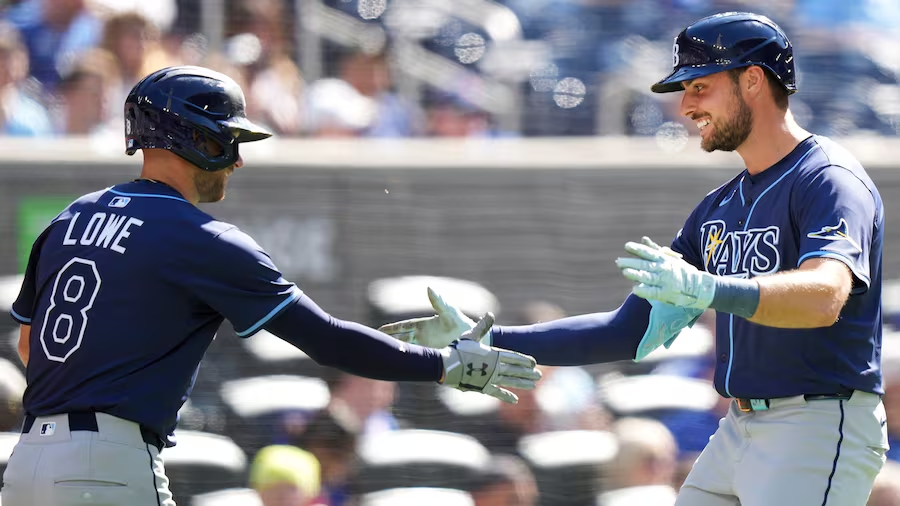
But Brandon’s game encompassed much more than that. He had plenty of power for the position and was a machine against right-handed pitching. One replacement strategy is a platoon of left-handed hitting Gavin Lux and solid defender Ben Williamson. Lux has struggled with the yips in the past, though this tandem still figures to shore up this defensive weak spot. Unfortunately, they yield 10-20% at the plate dependent on Williamson becoming a more efficient hitter.
Right fielder Josh Lowe found a bottom across the board in his third full-time MLB season. The 28-year-old left-handed hitter slashed .220/.283/.366 and stole less bases than in 2024 despite 12% more plate appearances. And with switch hitter Jake Mangum also out the door, manager Kevin Cash will utilize a new platoon to improve on the position’s 78 wRC+. As of now, a Jake Fraley/Jonny DeLuca pairing is a firm fielding upgrade with an offensive floor similar to last year’s production. Replacing the two Lowes with aggressive platoons should begin to correct the team’s big declines against southpaws of the past couple seasons.
Refreshing a Stale Lineup?
Shortstop continues to be a black hole ever since Wander Franco’s exile from the MLB a couple years ago. Old standby Taylor Walls is a Defensive Runs Saved monster but carries a career .195/.286/.298 slash line over 1,560 plate appearances. Top prospect graduate Carson Williams has a golden opportunity to seize the job at short after last summer’s debut. Except the 22-year-old continues to strike out a ton. Yet the bar set by the 2025 collective at shortstop leaves 5-10% of improvement even with Williams developing in real time.
However, another hot prospect graduated with high marks last season. Third baseman Junior Caminero did not disappoint, smashing 45 home runs with a .264/.311/.535 slash line worth a team-leading 4.6 WAR. He gives some value back in the field but the bat is well worth the tradeoff. His first full season in the Majors featured improved plate discipline and contact, producing a 14.0% barrel rate. A massive disparity in home/road splits urges a deeper look for projections as the Rays return to Tropicana Field. Regardless, Caminero has youth and bat speed on his side for another huge season.
Longtime Orioles’ centerfielder Cedric Mullins is no longer a spring chicken and has lost a step in the field. Yet the 31-year-old left-handed hitter still runs the bases well and hits righties just fine. Keeping his head above water against lefties is just as important though. Sure, Jonny DeLuca is a suitable short-side partner in the outfield. Except he cannot physically replace all three left-handed players at the same time. So a fair amount of stock is being placed in Justyn-Henry Malloy, the odd man out of Detroit’s stacked outfield. Malloy should play a role in stopping the Rays’ bleeding against lefties as a partner to Chandler Simpson as he shifts to left field.
In Good Hands
First base and designated hitter are locked down with rock solid hitters Yandy Diaz and Jonathan Aranda. As the senior member of the position player corps, Yandy has settled in nicely as a plus-25% hitter on Kevin Cash’s lineup damn near every day. Aranda spiked in his first full season with the Rays, slashing .316/.393/.489 that adjusts to a plus-20% range after moving back home to the Trop. Make no bones about it, Tampa Bay has corner infielders that can flat out mash.
You can’t say the same thing about the Rays’ catchers. Last year’s 0.3 WAR ranked 28th with Danny Jansen leading the group offensively before his trade to Milwaukee at the deadline. As a response to moving on from Jansen, Tampa Bay picked up Nick Fortes from Miami the next day and now rides with him as their primary backstop. Fortes and Hunter Fedducia defend the position fine but fall short of league-average hitting by 10-20%. That would be an improvement over 2025’s revolving door of catchers not named Danny Jansen. Expect the 2026 duo’s defense to settle out towards neutral regardless of rating system.
There’s been a significant amount of change within the Rays position player group compared to this time last year. And with this front office, that should come as no surprise. The defense ranges from solid to firmly plus, depending on which grading system you prefer. Losing productive runners Jose Caballero, Jake Mangum, and Josh Lowe will affect the offense’s potency beyond the top-line numbers. So the early read on Tampa Bay’s lineup is essentially a lateral move with some rebalancing of splits without the Lowes on the roster.
— Rotation —
Front office chief Erik Neander has not been shy about shuffling the rotation’s deck either. Last season’s starters continued to hang around league-average in many respects like innings pitched (850.2), strikeout and walk rates (22.2%, 7.8%), ERA (4.03), and WAR (10.8). The multi-year performance plot below reflects the gradual trend of more innings, higher ERA and FIP not unlike most middle-of-the-road units. And while it may not make a huge impact to the 2026 rotation’s numbers, this will be the first season since 2020 that neither Taj Bradley nor Shane Baz will make a start for the Rays. That is, unless one of them is traded back to Tampa Bay. Never count out this organization to pull off something like that.

These former Rays’ top prospects never truly got off the ground. Both had good, but limited, 2024 campaigns and performed well enough last year to become trade chips. Shane Baz was flipped to the Orioles this winter for a haul of younger players; reliever Griffin Jax came down from Minnesota for Taj Bradley at the trade deadline. The tandem of Zack Littell in the first half and Adrian Houser in the second leaves a 32-start, 189.2-inning hole right next to those two.
The Cupboards Are Far From Bare
Top performers Drew Rasmussen and Ryan Pepiot return atop the 2026 rotation with a combined 4-5 WAR outlook similar to last year. Rasmussen’s return from internal brace surgery inspired enough confidence for a rotation spot last season. His 31 starts at 2.76 ERA and 3.84 FIP/3.72 xFIP earn mid-3.00s projections that factor in regression from a .246 BABIP. Not bad at all, though Kevin Cash would like to get the 30-year-old righty back above the 5 innings/start threshold in his second full season post surgery. Rasmussen’s pitch quality and heavy ground ball action should continue to play well.
Ryan Pepiot also has a spot reserved in the rotation for a third straight year since leaving the Dodgers. A massive disparity with his home run rate at Steinbrenner Field bodes well for the Rays’ return home, though he is tagged with a projected ERA around 4.00 after 2025’s 3.86 ERA and 4.36 FIP/4.07 xFIP. I’m not completely sure if that fully adjusts for Pepiot’s tougher results in the Yankees’ Spring Training/Single-A park though.

Lest we forget about southpaw Shane McClanahan and his once-electric stuff. Late-2023 Tommy John surgery plus last year’s nerve injury effectively shut down the 28-year-old for two seasons except for three Minor League outings in July. He gets projections ranging throughout the 3.00s because we simply do not know how his pitches will play in the Majors this year. Cautious 20+ start expectations still generate 2-3 WAR for the rotation. As a point of comparison, that’s an upgrade over Taj Bradley’s 2025 body of work.
No Shortage of Options
Flexible right-hander Nick Martinez signed a 1-year/$13M deal to bolster the rotation and add innings to the bullpen. Two seasons of this type of work in Cincinnati laid out a blueprint that the Rays can appreciate. The pitch-to-contact veteran seems to have settled in as a 4.00+ starter who is most effective in relief, similar to his left-handed counterpart Steven Matz. At minimum, their stints in the rotation will buffer the others’ injury risk and buy some time until the younger talent is ready.
Former Athletics’ left-hander Joe Boyle will get a shot because of his promising secondaries. Boyle’s problem is a general failure to command his arsenal which has handcuffed him to a career 14.3% walk rate over 115.2 innings. 2020 second round draft pick Ian Seymour is a soft-tossing southpaw who put up a 3.16 ERA and 2.04 FIP/3.16 xFIP in five starts toward the end of last season. Negative home run regression keeps Seymour’s projections for a longer tenure in 2026 around the 4.00 mark. The Rays will undoubtedly kick the tires on him again at some point.
Tampa Bay’s starting pitching pipeline is stocked, though Yoendrys Gomez, Joe Rock, and maybe even Brody Hopkins are the ones in the bunch who could impact the rotation in addition to Boyle and Seymour. Kevin Cash has a lot of options to navigate in light of the injury risk surrounding McClanahan, Pepiot, and Rasmussen. With all that under consideration, the 2026 rotation has 2-3 wins of upside barring catastrophe. There’s enough veterans on board for stability plus a handful of interesting arms yet to prove themselves.
— Bullpen —
There were plenty of positives associated with the Rays relief pitchers. 2nd best strikeout rate (26.0%) and walk rate (8.1%) combined for an MLB-leading 3.20 K/BB ratio. Their 3.81 ERA and 3.97 FIP/3.75 xFIP sits above average though converting just 55.6% of save opportunities and notching a 26-33 record stifled the Rays’ late game success. By many accounts, this was a typical Tampa Bay bullpen with respect to the last few seasons. But incumbent closer Pete Fairbanks headed south to Miami after his club option was declined, turning the high-leverage operation over to a committee of sorts.

Edwin Uceta rose the ranks from a promising 2024 season (1.51 ERA, 1.70 FIP/2.49 xFIP) right into a 2025 letdown. Exhibit A: his 7.13 K/BB ratio was slashed to 3.81 across the full 76.0-inning campaign. And keep an eye on his recent bout with shoulder inflammation. Fortunately, Cash has two other 30%+ strikeout guys to anchor the back end in Garrett Cleavinger and Griffin Jax. The 31-year-old lefty Cleavinger throws hard and gets plenty of whiffs with a wicked slider. Mid-season acquisition Jax also pounds the strike zone with a plus arsenal featuring heavy doses of a wipeout slider and deceptive changeup. One thing to monitor is last year’s hard contact spike and reduced ground ball rate that either led to or resulted in a rough .368 BABIP.
Middle relief ranges from good to might not be on the roster for long types of pitchers. Bryan Baker returned to respectability last season after bouncing on-and-off the Orioles roster. He joins Mason Englert – who finally put together effective pitches with good control – as right-handers who should add some meat to the bullpen. Otherwise, a little old fashioned trial and error should determine who from the Steven Wilson, Cole Sulser, Hunter Bigge, and Kevin Kelly contingent will stick as middle relievers. Time will tell if the bullpen’s navigation of late-inning situations improves. In the meantime, we have Tampa Bay’s relievers at a similar valuation as 2025 with room for upside.
WAGER: Rays Over 76.5 Wins
Baltimore Orioles 2026 Win Total: Open 84.5, Now 86.5
2025 Result: Under 88 (75-87 / Pythag: 70)
The wheels quickly fell off the Orioles’ wagon last season, pushing out manager Brandon Hyde after a 15-28 start. General manager Mike Elias wanted new leadership in the dugout and that’s what they have in new skipper Craig Albernaz. Baltimore looks to rebound back into the upper ranks of the division – a task becoming even more difficult given the stacked rosters in Toronto, New York, and Boston. It will take a significant turnaround from the O’s young core to find their way back to a 100+ win season like in 2023, let alone the 91 wins of 2024.
Offseason Personnel Changes
Additions:
- P Alonso (1B)
- S Baz (SP-R)
- T Ward (OF)
- C Bassitt (SP-R)
- R Helsley (RP-R)
- B Alexander (INF)
- J Noel (OF)
Subtractions:
- G Rodriguez (SP-R)
- T Sugano (SP-R)
- G Sanchez (C)
BetCrushers 2026 Win Projection Range: 84 – 91

— Position Players —
2025 was a very forgettable season in Baltimore as most aspects of the team stumbled to the bottom of the AL East. Their exciting lineup full of talent sunk to new lows. Fewer home runs and more strikeouts led to the MLB’s 20th best park-adjusted 96 wRC+. That’s a far cry from 2024’s 117 wRC+, which was 4th in the Majors. All told, the Orioles scored 109 fewer runs and seemingly packed it in down the stretch as Cedric Mullins, Ramon Laureano, Ryan O’Hearn, and Ramon Urias were shipped at the trade deadline. Needless to say, our projection for improved outfield defense and another plus-10% lineup fell flat on its face.

A good place to begin dissecting Baltimore’s woes is the key group of 20-somethings who were the lightning rods of the 2024 offense. As shown in the plot below, shortstop Gunnar Henderson led this previously dominant lineup that lost its juice. Was his fall from having the 11th highest slugging percentage among qualified hitters foreseeable? Perhaps. Though another force may have been in play. Turns out that Henderson playing through a shoulder impingement for the majority of the 2025 campaign was a key force behind his slump. If that’s the case, look for Gunnar’s hard contact to rebound and production to improve accordingly.

Getting Back on Track
Third baseman Jordan Westburg’s injury woes ate into a productive season punctuated by a strong summer. Missed time seems to be part of the 27-year-old’s profile and is the biggest knock against heartier projections for 2026. A partial UCL tear suffered at the onset of Spring Training is the current malady sidelining him through at least April. While last year’s rate statistics serve as a baseline moving forward, playing time is the highest variance variable in his outlook. Next man up is the young Coby Mayo who represents just a 10-15% reduction in the interim.
Catcher Adley Rutschman shares that distinction after a couple month-long stretches on the IL. It is a brutal position to play and 2025 was the first instance of him missing significant time. Better fortunes in that department plus rebounding from a rough .240 BABIP puts him back as a plus-10% bat and solid defender. How important is Rutschman’s presence in the lineup? Baltimore leaned on six other backstops to fill in the gap with varying levels of effectiveness. One of them was the O’s former top prospect Samuel Basallo, whose brief debut leaves a lot of room for growth. To be fair, the 21-year-old destroyed Triple-A pitching before his call-up. Basallo’s defense may pale in comparison to Rutschman’s but it shouldn’t be any worse than most of last year’s fill-ins.
Outfielder Colton Cowser had a little bit of the Jordan Westburg effect as well. Plenty of missed time due to injury without dragging down hard contact. He can play center well and excels in left field. Whether injuries or regression – or both – knocked down his batting average and BABIP by about 50 points is beside the point. Most projections put Cowser back on track as an average+ bat with solid defense and base running. After last year’s woes, it shouldn’t be a surprise that these four centerpieces are penciled in for a collective 5+ additional wins of value over 2025.
Extra Fuel in the Tank
First base was another soft spot compared to 2024. The Ryan O’Hearn/Ryan Mountcastle pairing dropped about 10% into 2025, prompting the need for new blood at this bat-first position. O’Hearn was dealt to the Padres at the deadline which gave prospect Coby Mayo additional reps there. Doubling down on their abundance of right-handed hitting first basemen, Mike Elias plucked former Mets slugger Pete Alonso out of free agency to anchor this position. The veteran does not suffer from lopsided splits and smashed the ball harder than ever last year. A defensive downgrade at first base is a small price to pay for a 30-40% offensive lift from a guy who played in every game from 2024-2025.
Additional roster shuffling comes to the outfield via longtime Angel Taylor Ward. Left field is another position that lost 10% at the plate between 2024 and 2025. Veteran Ramon Laureano found a second wind then was traded at the deadline, leaving the door open for Colton Cowser and Dylan Carlson to platoon there. 32-year-old Ward stabilizes left field with a steady plus-15% bat representing a 20% upgrade. He’s another one who hits both lefties and righties at an above-average clip, though his numbers against southpaws are naturally sharper.
Last summer’s Cedric Mullins trade opened up Baltimore’s center field for the first time in the 2020s. The beloved Mullins’ defense started to slip but he did leave town on a high note offensively. This is now Colton Cowser’s position to lose, though it is clear a short-side platoon partner is needed. Prospect Enrique Bradfield Jr. is not quite ready after reaching Triple-A last year with shaky results. In the meantime, someone like Leody Taveras can fill that gap. Unless Craig Albernaz struggles to find a righty hitter to pair with Cowser, this is another position that stands to gain 10% offensively.
Better Days Ahead
Henderson, Rutschman, and Cowser have 10-20% offensive improvement in their crosshairs as part of their anticipated rebounds. Adley and Samuel Basallo are candidates to occupy the catcher and designated hitter spots on most days in order to keep their bats in the lineup. Granted, the younger half of this backstop tandem has yet to prove himself in the Majors while Rutschman faces a crossroads of sorts with his future.

22-year-old Jackson Holliday took a much-needed step forward after a tough MLB debut in 2024. He made the 2025 Opening Day roster and hung in there for a healthy 649 plate appearances. Plate discipline improved without much sacrifice to hard contact. The flip side to that is way too many ground balls that cost Holliday bigger numbers. Unfortunately, he’ll miss Spring Training and the start of the season recovering from a hamate fracture. Jackson should ultimately get the lion’s share of work at second base but may need a right-handed partner to shore up his weakness against left-handed pitching. Picking up Blaze Alexander as infield depth several days before Holliday’s injury turned out to be a timely addition as well as a possible platoon answer, if needed.
Rookie Dylan Beavers flashed in his second half call-up, showing that his dominance in Triple-A was not a fluke. The 24-year-old didn’t knock the cover off the ball in the Majors but fits the profile of a speedy, extra base hitter in the bottom half of the lineup. A group approach to right field with Beavers, Tyler O’Neill, and Jeremiah Jackson should be firmly above average, though likely the only position that actually falls a bit from its 2025 production. That’s a positive sign for the Orioles offense to pop by 5-8% in the year to come, landing somewhere near their 2023 levels. Modest, incremental improvements for both the outfield and infield – Pete Alonso notwithstanding – gets the team’s fielding back towards neutral.
— Rotation —
Baltimore’s starting pitching situation was finally starting to get somewhere. Then it went backwards, from top ten to bottom ten. The Corbin Burnes/Grayson Rodriguez-led group of 2024 gave way to a crew that, as a whole, did not excel at much other than avoiding bases on balls. Veteran Charlie Morton and Japanese free agent Tomoyuki Sugano posted 5.72 and 4.64 ERAs, respectively, as younger talent like Cade Povich and Brandon Young did not make the type of impact the club was looking for.

Diamond in the rough Trevor Rogers returned from a knee injury to deliver his best season since breaking out with the Marlins in 2021. Injuries and 4.00+ seasons led to his trade in mid-2024 for Connor Norby and Kyle Stowers. Considering the latter just delivered a 4.0-WAR season in Miami, the O’s truly needed Rogers to deliver. And he did. In 18 starts, the left-hander put up a 1.81 ERA and 2.82 FIP/3.64 xFIP with a 3.55 K/BB ratio. This reversal of form from 2024’s ineffective 1.73 K/BB creates some pitfalls for the season ahead. That includes dealing with a .226 BABIP that was nearly 100 points lower than the year before and a home run rate about half of his usual. In spite of those headwinds, Trevor’s improved conditioning, lower body strength, and revamped slider should keep him around the 4.00 mark in 2026.
Putting Things Together
What manager Craig Albernaz should be excited for is the return of Kyle Bradish from Tommy John rehab. After missing the better parts of the last two years, the 29-year-old returned in late August for 6 high quality starts. A conservative approach to a 25+ start campaign pegs him for a mid-to-upper 3.00s season around 3 WAR. As a 4.00+ veteran, free agent right-hander Chris Bassitt doesn’t quite have the upside that Rogers and Bradish present. What he does bring to the table is innings. Four straight 30+ start, 170+ inning seasons from a solid ground ball pitcher is a strong addition to a group with a fair amount of uncertainty.
This trio is joined by former hyped-up prospect Shane Baz via trade with Tampa Bay for four Minor Leaguers and a comp pick. Injuries derailed the 26-year-old’s attempts to hang in there for a full season until last year when he made 31 starts at 5.36 innings/start. Baltimore’s front office was not deterred by the former Ray’s 4.87 ERA driven by a home run rate that is commonly attributed to Tampa Bay playing their home games at Steinbrenner Field instead of The Trop. You can see what the O’s hope to be fluky home/away splits:
S Baz Home/Away Splits (2025)
| IP | ERA | FIP/xFIP | HR/9 | Slash Line | |
|---|---|---|---|---|---|
| Home | 82.1 | 5.90 | 4.96/3.89 | 1.97 | .271/.338/.489 |
| Away | 84.0 | 3.86 | 3.79/3.87 | 0.86 | .227/.312/.373 |
| Season | 166.1 | 4.87 | 4.37/3.88 | 1.41 | .250/.325/.433 |
A nearly identical xFIP across these splits gives reassurance that Baz has better days ahead. Steinbrenner Field had the fourth highest park factor for home runs last year per Statcast. That said, Baltimore’s friendly confines actually ranked second in that department. Prospect analyst Eric Longenhagen broke down Shane’s enhanced pitch repertoire and hinted at further improvement in the O’s system a la Trevor Rogers. A healthy Baz offers a 2 WAR floor with upside.
30-year-old Dean Kremer has consistently delivered low-4.00s production for several years now, making do with a ground ball contact approach resulting in less hard contact than his early years. His broad arsenal is good enough to slot him as a 1-2 WAR fourth or fifth option in the rotation similar to veteran Zach Eflin. The right-hander looks to rebound from back surgery, a 9.4% barrel rate, and a declining strikeout rate. Eflin’s 5.93 ERA could be an outlier given his back troubles, landing projections in the mid-4.00s assuming 2025’s spike in hard hit balls was a symptom of injury.
Depth: Where the Rubber Meets the Road
Kyle Bradish, Trevor Rogers, and Shane Baz have injury histories that necessitate a deeper pool of starting pitchers. This is another reason why the Chris Bassitt addition helps lift the rotation’s floor. Yet more is indeed better when it comes to starters. Do the O’s have the stable to keep the wheels moving for 162 games? The first line of defense is former starter Tyler Wells, who likely starts the season in the bullpen. A prime swingman candidate, Wells also has a lengthy injury history and a tough time keeping the ball in the yard. Another candidate is Cade Povich, who has bounced back and forth between the Minors during his first two MLB seasons. The southpaw has plenty of options in his repertoire but has been quite hittable to begin his career.
Less experienced options include 27-year-olds Chayce McDermott and Brandon Young. Young struggled in 12 starts as a rookie (6.24 ERA, 5.35 FIP/4.52 xFIP) and McDermott hasn’t quite corralled his command in the Minors (16.5% BB in 2025). Baltimore gave up a key arm in Grayson Rodriguez to obtain Taylor Ward, further compromising starting pitching depth. But life is all about tradeoffs – and this is one of them. Even with injury concerns baked into playing time estimates, the 2026 rotation should be 2-4 wins better.
— Bullpen —
Unsurprisingly, Baltimore’s relief unit also trended down last season. Was its .308 BABIP (4th highest) a sign of unluckiness? Maybe, though yielding the 3rd highest walk rate (10.5%) is a flaw inherent to the staff. Regulars like Felix Bautista, Cionel Perez, and Seranthony Dominguez posted 13.7% or higher walk rates. Fortunately, Bautista and Dominguez also delivered gaudy strikeout rates over 30%.

As Mike Elias grasped the reality of 2025 being a lost season, big names Andrew Kittredge, Seranthony Dominguez, Bryan Baker, and Gregory Soto were all jettisoned before the trade deadline. Ironically, Kittredge was re-acquired from the Cubs this winter for cash. Also missing from this year’s group is closer Felix Bautista as shoulder surgery will keep him out for nearly the entire season. Remember that Bautista missed all of 2024 after Tommy John surgery.
How Do They Get Better?
Help is on its way. The volatile combination of arms that generally lacked punch gains fireballer Ryan Helsley to anchor the 2026 unit. Assuming the 31-year-old’s super hittable persona in New York is a thing of the past, the righty is “primed for a Baltimore bounce back“. Helsley is penciled in as a sub-4.00 reliever, though there are differing opinions on just how sub that will be. Former St. Louis teammate Andrew Kittredge and left-handed workhorse Keegan Akin also fit the sub-4.00 mold. Akin battled command issues to the point where his typical 6% rate doubled and home run rate drifted upwards.
Yennier Cano could re-emerge as a workhorse but his effectiveness has steadily dropped off since breaking out in 2023. Dietrich Enns was decent upon return from a three-year hiatus overseas. He joins the less-experienced ground baller Colin Selby as under-the-radar middle relievers with promise. Ryan Helsley makes this year’s bullpen stronger, though it is yet to be seen whether the unit as a whole is meaningfully better.
2026 AL East Projected Standings
- Toronto Blue Jays (93-69)
- New York Yankees (92-70)
- Boston Red Sox (90-62)
- Baltimore Orioles (89-63)
- Tampa Bay Rays (80-82)
Take Your Base!
That’s four division previews down and two to go. To catch up on the first three preseason outlook articles, visit the MLB page at BetCrushers.com where all of our baseball content for the season lives. Stay in the loop by following us on X or subscribing below for email notifications:


